
Perennial veggetables are crops that you plant just once and harvest year after year. Some say a perennial can also be any vegetable that will continue to be productive for more than two years. They require little maintenance and can provide a rich harvest of produce and are key to Permaculture principles.
Perennial vegetables are deeper rooted than annuals, so they are hardier in times of drought and are often more resistant to pests and disease. Also, thanks to their deep-rootedness, they draw up and incorporate into their tissues, a lot more trace minerals than the better-known garden vegetable varieties.
No yearly tilling of the soil is needed, so perennials allow the soil to stay intact which promotes healthy soil structure and a teeming habitat for animals, worms, fungi and bacteria. As years go by the plants keep adding more and more organic matter to the soil as they lose their leaves. This builds topsoil and allows those same perennials, and much more, to thrive.
Here’s a list of some of the perennial veggies you can plant.
Artichoke
It is beautiful from head to toe, and although it has a long growing season, the flavor is well worth the wait. Artichokes can be grown either as an annual or a perennial. In the latter case, they must be protected during the winter months.
Before planting, find out what varieties grow best in your zone, then wait 2 years for the first harvest.
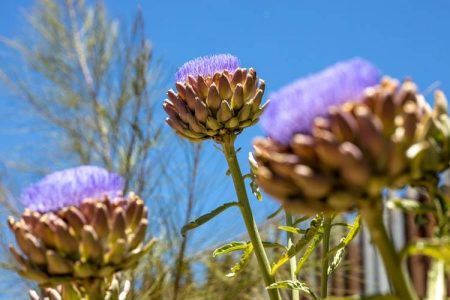
Photo by Julian Dutton
Asparagus
If you have extra space in your garden, asparagus will be happy to take it over. It grows both tall and wide, giving you a couple of decades’ worth of asparagus spears in exchange for your loving care.
They can be choosy about where they reside and love sun and soil that drains well. Once they are planted, they are there to stay. Asparagus can be grown from seed but it’s much easier to plant bare-root crowns directly into the ground.
Growing Notes
Soil – Fertile, well drained, and free of persistent weeds.
Position – Full sun to partial afternoon shade.
Frost tolerant – Long-lived hardy perennial. Beds can produce for decades.
Feeding – Mulch with 5cm (2 in) of rich compost or rotted manure every winter.
Companions – Calendula, Tomato, Marigold and Petunia.
Spacing – Single Plants: 45cm (1′ 5″) each way (minimum)
Rows: 45cm (1′ 5″) with 45cm (1′ 5″) row gap (minimum)
Sow and Plant – Set out dormant 1-year old roots, called crowns, in late winter or early spring. A few varieties can be grown from seed.
Care – After the stems die back in early winter, cut them off at ground level and compost them. Remove weeds, apply compost and mulch, and your yearly maintenance is done. Cutting new shoots just below the surface often helps control problems with asparagus beetles, which often lay their eggs on tender shoots near the soil line.
Harvesting – Begin gathering spears the second year after planting, cutting all spears that appear for a month in early spring. In subsequent years, harvest for 6 weeks each spring.
Rhubarb
Though the temptation is hard to resist, you cannot harvest rhubarb in the first year, you must first wait for it to establish roots. You will have to wait and see how this plant will only get bigger and bigger as the seasons’ pass.
It is said that a single rhubarb plant can last 20 years, before needing to be replaced. In the meantime, enjoy all you can of the tart stalks, being careful to stay clear of the leaves which are poisonous.
Rhubarb pairs well with strawberries – which are also a perennial of the fruiting kind!
Growing Notes
- Soil – Well-drained soil with plenty of compost dug in.
- Position -Sun or partial shade.
- Frost tolerant – Yes, but leaves and shoots die back.
- Feeding – Mulch with extra compost each year after the leaves have died down.
- Companions – Strawberry.
- Spacing – Single Plants: 90cm (2′ 11″) each way (minimum)
Rows: 90cm (2′ 11″) with 90cm (2′ 11″) row gap (minimum) - Sow and Plant – Grown from a crown (root) which can be split from a healthy plant and planted out, usually in mid-winter.
- Growing tips – Early sweet stems can be produced by forcing and blanching the rhubarb: in mid winter to early spring add dry material such as leaves or straw and cover with a deep container or bucket to exlude light for about one month.
- Harvesting – Do not harvest during the first year of growth. After this, pull a few of the thicker sticks when long enough. Stop harvesting in early summer and allow plants to grow freely for the rest of the season.
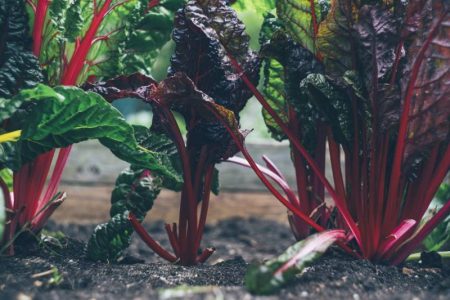
Chard
These are beautiful with their different colour stems, provide greens almost all year round, you can just cut off the individual leaves as you need them. Easy to grow from seed.
Chives
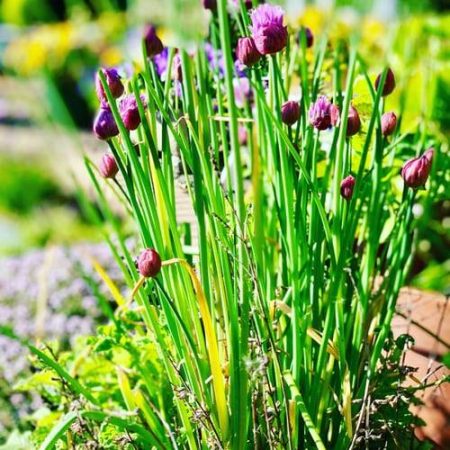
Chives are very hardy and such vigorous growers in fact, that they will need dividing every few years. Wonderful to step outside, harvest a small bunch, chop them up and add them to salads and dips.
Jerusalem Artichokes
Jerusalem artichokes are tasty, available all winter, exceptionally easy to grow, completely undemanding, very low-maintenance and ideal for beginners. They are also low in calories and contains inulin, a carbohydrate that feeds your gut bacteria. Can be eaten raw or cooked
Growing tips
- Soil – The tubers grow in just about any soil but prefer alkaline conditions.
- Planting: Plant tubers 4-6 inches (10-15 cms) deep, 12-18 inches (30-45 cms) apart. If they are already sprouting, make sure the shoots are pointing upwards, and be gentle, as they break off quite easily. If you don’t have many tubers, you can cut them into pieces (don’t let these dry out), ensuring that each piece has a bud on it, and plant those. NB: One tuber can produce twenty!
- Position & caring: keep them watered and earth up the stalks as they grow. Because they grow so tall (easily reaching ten feet or more), the plants can suffer wind-rock, or overshadow other crops. If this is likely to happen, cut stalks down to around 4 feet (120 cms) high in mid-summer. This will make them bush out and creates more compact plants. It also discourages flowering (which begins in autumn) and, instead, encourages them to put their energy into growing bigger tubers. Their flowers provide some late nourishment for insects at a time when many flowers have long gone, though, so rather than cutting them back, you could corral them with deeply set canes and wires, so that they don’t wave around over the bed.
- Harvesting – Jerusalem Artichokes aren’t easy to store well but one of their advantages is that they’re quite happy left in the ground until you need them. If your ground tends to freeze, mulch well to ensure that you can extend the harvest period. If you do need to store them, ensure you put them somewhere very cool and with high humidity to help prevent them from shrivelling.
- Replanting for the following harvest – It’s not necessary to dig them all up if you’ve created a permanent bed for them, but they’ll become congested in a couple of years if you don’t. So, in early spring, dig over the bed, removing all you can find and replant (in the same place if you wish) the smoothest, biggest ones you come across. This helps ensure less knobbly artichokes in future years.
Perpetual Spinach
So easy to grow and provides leaves all year round.
Sorrel
This is a common wild edible plant, that is one of the earliest greens to emerge from the soil each spring. Call it tangy, zingy or lemony, sorrel has a unique flavor that takes some getting used to. And yet it provides many essential nutrients just as we are coming out of winter. Sorrel produces well until June, then it begins to flower. You’ll want to pick the leaves while they are young and tender for the finest sorrel sauce. If you don’t already have it growing wild in your garden, find some seeds and plant your own.
Wild Rocket
Plant from seed and enjoy them for most of the summer & autumn, year after year. An easy salad crop that doubles as a cooked green. Flower buds are also edible. Hot weather causes leaves to become very strongly flavored.
- Soil – Fertile, well drained soil that holds moisture well.
- Position – Sun or partial shade. A cooler, shady position in summer.
- Frost tolerant – Yes, tolerates mild frosts.
- Feeding – Not required.
- Companions – Beans, Dill, Lettuce, Mint, Nasturtium and Thyme.
- Spacing – Single Plants: 15cm (5″) each way (minimum)
Rows: 10cm (3″) with 20cm (7″) row gap (minimum) - Sow and Plant – Sow direct into the soil from early spring onwards or under cover for an earlier sowing in mid-late winter. Can also sow in early autumn for a winter crop.
- Harvesting – Harvest in small batches as required. Once it flowers the leaves become tougher and hotter in taste.