A composting toilet is a type of dry toilet that uses no water for flushing and turns human waste into compost-like material.
It is great for any place where there is no access to running water or connections to septic tanks or sewer systems.
When researching different types of compost toilets for St Ives Community Orchard we found there were quite a variety to choose from.
We installed the simple bucket system compost toilet in 2021 as it was easy to install, fitted in the small space we wanted to use and suits small-scale use. It’s an ideal system for people who know how to use it but at our events the urine separator often gets blocked due to people not understanding where to put the toilet paper. We’ve since thought that the tree bog would be more suitable so we may switch to this system as it doesn’t need the urine separator. Recently seen this Woowoo Loo Compact Compost toilet and it looks perfect for our needs but expensive.
A bucket of sawdust is provided in the compost toilet – this carbon additive promotes aerobic decomposition, improving the carbon-to-nitrogen ratio and reducing potential odor. The filled bucket is then moved to another compost bin – to allow more time for composting.
Here is more information on the various compost toilet there are a few options.
Bucket System
This is a very simple compost system – if it’s for a small number of people a simple 20l bucket is fine.
It’s essential to have a urine separator for this type of compost toilet which redirects the urine into a soakaway pit or separate container.
For more regular use, you can fit a large wheeliebin underneath or some people use 1000l water tanks. (See the Thunderbox toilets)
The toilet then needs to be raised higher off the ground to accomodate this.
In our community orchard a bucket system works well when it’s just used by our regular volunteers.
The bucket is easy and light to empty, we have a compost bin for this purpose where it breaks down further.
The soakaway pit is simply a small hole behind the toilet filled with stones and then soil on top.
We make sure that both the compost bin and the soakaway pit is far away from any area where we may grow vegetables and both are densley surrounded with bush.
We have a bucket of sawdust we get from the local woodworkers and ask people to put a cup of sawdust after a poo. Nothing needed after a wee. At larger events we tend not to put out the sawdust bucket as people put too much in and often block up the urine separator with it.
It’s essential to have a urine separator for this type of compost toilet otherwise it gets really smelly and fills up too fast. However the urine separator creates problems when people don’t know how to use it. The small hole that leads to the pipe gets blocked up with sawdust, toilet paper and sometimes poop when kids use it, as they don’t sit far enough back. (prob needs a kid seat to put over it).
So this compost toilet isn’t ideal for events where we have many new people who don’t know how to use it and don’t read instructions
Here are a couple photos of our compost toilet. We bought a simple shed, fitted the box with a lid that lifts up on hinges to retrieve the bucket and we direct men to do standing wees on a haybale behind the shed.


//earthwateralliance.org/how-to-build-a-simple-bucket-compost-toilet/
Importance of urine separators:
Too much liquid means the compost will go anaerobic (lacking oxygen) and different bacteria will result. These bacteria give off methane and other offensive smells and make the whole process very unpleasant! A urine separator is the answer, thereby diverting urine away from the deposit container. These are more easily used by women than men as they are generally designed for the sitting position. Men can sit down to pee otherwise signs/instructions/alternative urinal facilities are essential.
A Tree bog
A tree bog is a great method. It’s a raised toilet and the area below has a meshed screen around packed with straw. It’s a good idea to grow willow around it to help with soaking up the liquids. It has an accessible area at the back and ideally you have 2 toilets so you can close one up for awhile to allow everything to break down before clearing it out.
The main benefits of this system is that a urine separator isn’t needed. A urine separator often gets blocked up with sawdust, toilet paper and poop because kids (and many adults) just can’t get it right. Also earthworms come up and help with the breakdown.
A great description on //www.woodlands.co.uk/blog/practical-guides/building-a-tree-bog/
A Pit Latrine (aka Long drop)
A pit latrine compost toilet is another simple waterless toilet. Basically you just dig a deep hole and put a shed with a toilet seat above it. You need enough space to be able to alternate toilets once they fill up though to give you a chance to empty one while the other is used. Not seen this method used in the UK much, mostly seen examples from developing countries. Perhaps because it rains too much here and the water table can become too high and could lead to groundwater pollution.
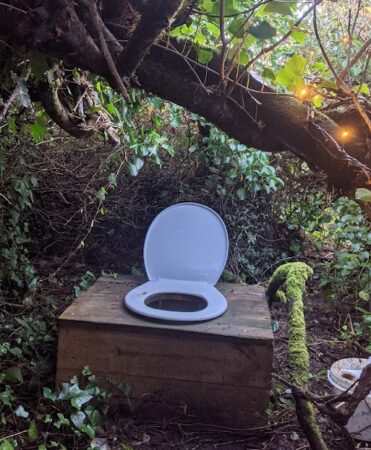
In our Community Orchard we have a very simple toilet like this. Simply a hole in the ground (about half a meter deep) with a box on top of it with a toilet seat. It was our first toilet we made before building a proper compost toilet. It’s hidden in the bush so it needs no walls or a roof for privacy. We call it our secret toilet and it isn’t used much but has been very useful.