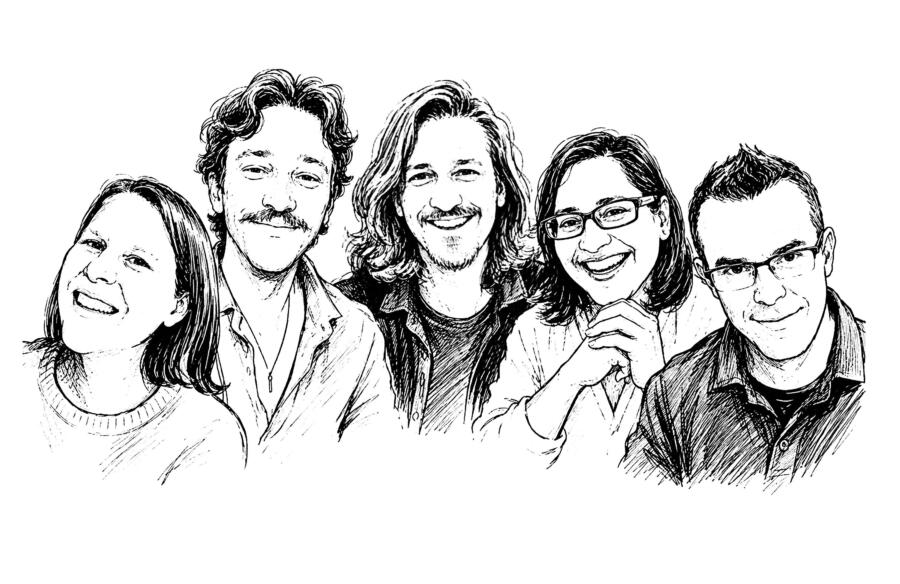
A group of regenerative practitioners approached us to ask if they could spend some time at the Orchard. We really appreciated the time they spent with us, and the thought and care they put into reflecting on their visit. At the end of their time here, they shared this article with us, which we thought was well worth sharing with you too.

“Every object, well contemplated, opens up a new organ of perception within us.”
– Johann Wolfgang von Goethe, writer, scientist and philosopher
Walk through St Ives Community Orchard on a summer afternoon and it’s easy to see what is growing: apple trees heavy with fruit, wildflowers alive with insects, herbs spilling from raised beds,
volunteers tending the land, children weaving between the trees, and music drifting across the hillside during one of the Orchard’s gatherings. It is, quite simply, a beautiful community orchard.
Yet after spending six months exploring the Orchard through The Regenerative Practitioner programme with Regenesis Institute, my study group and I began to suspect that the most interesting things growing here are not quite so obvious.
Our tutors often reminded us that regenerative practice begins by learning to see differently. At first, I wasn’t entirely sure what they meant. We hadn’t come to evaluate the Orchard or produce recommendations for its future. Instead, we had been invited to spend time with a living project and practise a different quality of attention, asking not, “What needs fixing?” but, “What is already alive here?”
It sounds like a subtle distinction, yet it proved surprisingly difficult. Like many of us, I was accustomed to looking for problems, gaps and opportunities for improvement. Instead, we found ourselves repeatedly drawn back towards strengths, relationships and possibilities already quietly taking shape. Only gradually did I realise that changing the quality of our attention was itself part of the inquiry.
As we explored potential projects across Cornwall and Devon, the St Ives Community Orchard immediately drew us in. Here was a community initiative that, in little more than a decade, had grown from the rescue and relocation of a small collection of apple trees into something far richer.
Perched on the slopes of Penbeagle Hill overlooking St Ives, and joined more recently by the beautifully crafted CORE Building and educational gardens, it felt like a place with an intriguing story
waiting to be understood. What we couldn’t have anticipated was how that story would begin to change us.
The longer we spent listening, walking the hillside and talking with the people who care for the Orchard, the more we realised we weren’t simply studying an orchard. We were being introduced to
another pulse of St Ives, one that quietly overlooks the town from Penbeagle Hill and is easily missed unless you choose to step into it.
Most people come to St Ives for understandable reasons: the beaches, the harbour, the galleries and the extraordinary quality of light that has inspired artists for generations. Our destination lay
somewhere rather different. Beyond the busy streets, on the edge of town, a community orchard was quietly telling another story. It was a privilege to witness.
Over time it became clear that this story wasn’t hidden so much as revealed through participation. We hadn’t uncovered a secret. Rather, by entering into conversations instead of simply making
observations, we slowly encountered a different understanding of the Orchard. Its character was carried less by its trees than by the relationships woven around them; neighbours, volunteers, growers, musicians, teachers, children and countless small acts of care. The deeper story wasn’tcontained within the landscape alone, but within the community continually shaping it.
Again and again, conversations revealed this quieter layer. Neighbours became volunteers, volunteers became stewards. Children learnt where food comes from by helping to grow it. Artists,
musicians and naturalists spoke of finding inspiration amongst the trees, while new ideas were often met with an instinctive “Why not?” rather than “Why?” Curiosity gradually became participation,
participation deepened into contribution, and contribution slowly fostered a shared sense of stewardship.
Standing on Penbeagle Hill, it became difficult not to widen the lens. Looking out across St Ives, the Orchard began to feel less like a destination and more like a vantage point from which to glimpse
the wider life of the town. The relationships nurtured here ripple far beyond the orchard gates into schools, creativity, local food, learning and neighbourhood life. What first appears to be a collection
of trees gradually reveals itself as part of a much larger living system. One of the things that surprised me most was the realisation that community itself isn’t something we manufacture. Like an orchard, its seeds are already present. The work is not to invent them but to create the conditions in which they can flourish. Given enough care, patience and attention, people begin to discover one another. Ideas take root. Confidence grows. Participation deepens into stewardship. In many ways, that feels remarkably similar to tending an orchard itself, where growth happens quietly, season after season, through countless small acts of care.
Perhaps we too often celebrate community only once it becomes visible through successful events, flourishing projects or growing visitor numbers. Yet spending time at the Orchard left me wondering whether these visible outcomes are actually the consequence rather than the cause. By the time a community appears to flourish, countless quieter acts of generosity, invitation and trust have already taken root beneath the surface.
Orchards also invite us into a different relationship with time. Few people plant fruit trees expecting to enjoy every harvest themselves. The work is carried out in trust, each generation tending something that previous generations began and future generations will inherit. During one of our final conversations, I found myself thinking about the original orchardists, and later the St Ives community who rescued and replanted those first apple trees on Penbeagle Hill. They could hardly have imagined every conversation that would one day unfold beneath those branches, every celebration, workshop or friendship that would emerge from their decision to plant. Yet they planted anyway.
There is something quietly profound in that gesture. To plant a tree is to place faith in a future you may never fully experience. It is an act of optimism disguised as horticulture. As our inquiry drew to
a close, I found myself returning to the question that had accompanied us from the beginning: What if the most important thing growing in a community orchard isn’t fruit?
After six months with St Ives Community Orchard, I still can’t answer that question with certainty. But I no longer think the harvest can be measured only in apples, workshops or volunteer numbers.
What appears to be taking root on Penbeagle Hill is something less tangible, yet perhaps more enduring. People come together to care for a landscape and, in doing so, discover new ways of caring for one another. Ideas find encouragement. Participation becomes stewardship. The character of St Ives continues to evolve through countless small acts of care, each modest in itself yet together contributing to something much larger. Perhaps that is what our tutors meant by learning to see differently.
Regeneration is rarely something we do to a place. More often, it begins when we learn to recognise, strengthen and participate in the relationships that allow a place to become more fully itself. Perhaps the apples are simply the most visible fruit of something much harder to see: a community continually learning how to tend a place and, in doing so, allowing that place to shape and sustain the community in return.
Simon Lown.
The Regenerative Practitioner Programme 2025, Regenesis Institute. //regenesisgroup.com/
If you’d like to explore the ideas behind this article in greater depth, you can read the full essay from our six-month inquiry into St Ives Community Orchard and the CORE Building using the link below.
//www.stivesorchard.co.uk/The-Orchard-as-Teacher-Essay.-v2.pdf