
Bracken is viewed by many as a problem plant but it is also a wonderful material and has great uses and benefits and often provides the perfect place for native woodland to return.
Bracken (Pteridium aquilinum) is a native British fern commonly found in woodland and heathland that can reach over 1.5m (5ft) in height. Bracken has thick, fleshy, brown-black underground stems that can travel long distances and produces spores of approximately 30 micrometres in diameter that are catapulted into the air between mid-August and mid-to-late September.
Benefits and uses of Bracken
-
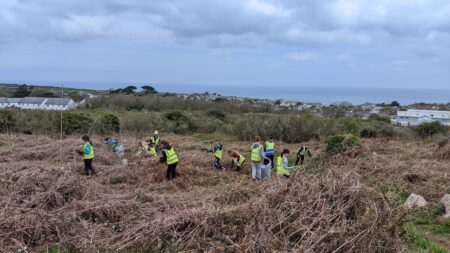
School kids helping to collect bracken on Penbeagle Hill
Bracken has traditionally been used for animal bedding, which later breaks down into a rich mulch that can be used as fertilizer / compost.
- It’s being used now in some commercial compost operations as a peat alternative . Read this article about a farmer who makes compost using bracken and pays other farmers by the bale for their bracken.
- Collecting it in winter when it is dry and brown is great for mixing into a compost heap and balancing out high-nutrient veggie waste.
- Bracken is also so good layered thickly as a mulch and has been shown to reduce the loss of potassium and nitrogen in the soil, and to lower soil pH.
- If you pick it in the summer months, usually late July/early august the fronds will be packed with nutrients, this is when they are at the peak of their growing season and just before the plant starts to transfer its energy down towards the roots for the winter. Green bracken ferns average 25 percent potash and can contain as much as 55 percent.
- Bracken can provide shelter for mammals, reptiles, amphibians, birds and insects. It is also a food source for many caterpillars. Fritillary butterflies live in habitats dominated by bracken and can be seen flying over the tops of the plant from April to mid-August. It is also one of the food plants of caterpillars of moths, such as the garden tiger, brown silver-line, small angle-shades, orange swift, gold swift, map-winged swift.
- Bracken substitutes the characteristics of a woodland canopy, and is important for giving shade to plants such as common bluebell and wood anemone where the woodland does not exist.
- The high humidity under bracken also helps mosses survive underneath.
- It’s an ideal space for regenerating new woodlands. As one authority on bracken says: “The planting of new woodland on land currently dominated by bracken is a long-term solution for control”. See //lostrainforestsofbritain.org/regenerating-rainforest/for more info on this.
- At the Leach Pottery they used the ash of Bracken as a glaze because of its high mineral content, picking at different times of year would apparently change the properties due to the varying mineral/nutrient content in the leaves throughout the season.
- Potentially a very effective carbon sink. In 2023, a survey was done by Zac Harris for a research project and he took a soil core to be tested from the area up on Penbeagle Hill, St Ives, where it is mostly bracken, with a really deep layer of decomposing bracken. He wrote that according to the raw data, the soil core taken from the area had 10 x more carbon than most of the other samples he’d taken from other areas. However this result would need further research to confirm this.
Why people don’t like bracken
Farmers hate it when bracken invades an upland pasture, it quickly overwhelms it, replacing grazing fodder with a plant that’s unpalatable (and indeed poisonous) to most livestock. The encroachment of bracken into grazing land reduces the area of useful farmland year by year since livestock cannot be allowed to eat it as it is known to be toxic, causing cancers. Ticks that cause Lyme disease in animals also thrive in bracken.
Conservationists are wary of it: bracken invasion can quickly transform biodiverse heath, moor or grassland into a monoculture. Over the last decades, bracken has increasingly out-competed characteristic ground-cover plants such as moor grasses, cowberry, bilberry, and heathers, and now covers a considerable part of upland moorland.
Bracken can out-compete desirable plants and invade bare soil, becoming a weed that is difficult to eradicate. Sometimes leading to a loss of wildlife habitat and invasion of Sites of Special Scientific Interest.
The shade from the tall, thickly spread bracken suppresses young tree growth.

Since 2013, over 2000 native woodland trees have been planted within the bracken on Penbeagle Nature Reserve. A small area of the bracken is cleared (aprox 1m squared) to plant the tree. In the summer months it is again cleared around each tree to ensure that the bracken isn’t blocking out the lights and again in the August it is checked that the bracken hasn’t fallen over the saplings. Although it is intensive work, this is only needed to be done for the first few years until the tree is higher than the bracken. Once the trees grow high enough to create shade, the bracken will naturally disappear revealing wildflowers that have up to then, been protected by the bracken’s shade. Below the bracken there were many bluebells, wood anemones and moss that had been shaded and protected in the absence of trees.


Interestingly, on one field where trees were planted, in Koos Govenek, instead of only clearing around each tree, the entire area was cleared of bracken over a few years. It looked beautiful in the spring where all the wildflowers that were usually covered in bracken were fully visible. In one area a mass of gorse started to take over in the absence of bracken and although gorse is very valuable to wildlife with many benefits, it can create impenetrable thickets which would make it harder for us to look after the woodland trees and led us to think that perhaps the bracken is preferable. One also wonders how long the bluebells would continue to survive without the protective shade of the bracken, before the woodland trees are tall enough to provide the shade needed.


St Ives Community Orchard was also covered in bracken and brambles and for the first few years, we often battled to find the trees amongst it. After aprox 3 years of cutting back it disappeared and was replaced by grasses & wildflowers. It’s a good idea, when cutting bracken, to introduce seeds like yellow rattle which helps to establish and maintain a naturally beautiful species-rich wildflower meadow and doesn’t allow a monoculture of grass to take over. When cutting back bracken it’s the perfect time to sow wildflower seeds as they won’t have tough grass to compete with. Cutting back bracken with a scythe is wonderfully satisfying.

2015

2015 clearing in the orchard

2015