St Ives Community Orchard and Nature Reserve was used as part of an interesting research project / dissertation by Zac Harris BSc Horticulture (Garden and Landscape Design) and Director: Gardens Of Eden. www.gardensofedenuk.com
He was looking particularly at food forests/edible forest gardens as a means to implement land restoration in inhabited/urban areas, to provide ecological ecosystem services as well as socioeconomic benefits with education and by providing food etc. He surveyed a variety of different places in Cornwall, taking soil samples and measured the carbon content of these.
MSc Land and Ecological Restoration Research Project.
‘Rus in Urbe’ for the 21st century, performing land restoration in inhabited areas by utilising greenspaces.
Click here for the full document.
An excerpt:
Could we utilise greenspaces and urban planting to implement urban land restoration and still provide some of the sociological benefits attributed to greenspaces and urban planting and if so, how?
This project will be looking at planting specifically to see to how different planting styles, themes and management may be more or less effective at providing a range of different measured ecosystem services, to help contribute, in a limited way, to research on urban land restoration.
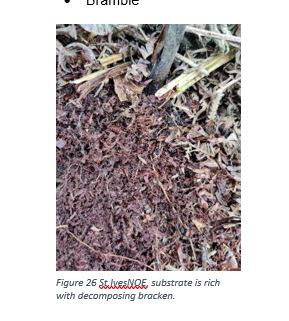
He found some interesting results, particularly in the area up on the hillside where it is mostly bracken, with a really deep layer of decomposing bracken on the surface, at least a foot deep. On this he wrote:
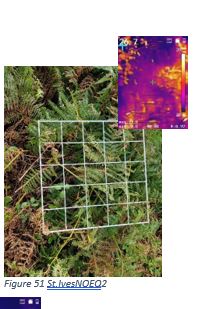
Another interesting piece of data is the NPOC content of St.IvesNOEQ2. According to the raw data the soil core taken from this acting treatment contained 148.6mg of NPOC, around 10x more NPOC than most of the other samples. This may be an error; however, further research may be useful for determining whether this data is correct and if this high NPOC content has been caused by the dominance of bracken as vegetative cover. St.IvesNOEQ2 contained mostly bracken as surface cover (see Figure 51 St.IvesNOEQ2) and the substrate was seemingly entirely comprised of decomposed bracken (see figure 26).
There may be a potential entire research project investigating carbon sequestration potential of bracken. See our further article on bracken.