

We have spotted quite a few mushrooms & fungi growing wild in our orchard and are excited at the thought of growing edible mushrooms, so finding out all about it. Watch this space.
Fungi are a huge and fascinating kingdom with over 15,000 species in the UK. They live on land, in the water, in the air, and even in and on plants and animals. They vary widely in size and form, from the microscopically small to the largest organisms on Earth (at several square miles large). Mushrooms (or toadstools) is a term given to the fleshy, here’s some information on 9 of the ‘common’ / amazing mushrooms in UK and more fungi & lichens.
Some mushrooms can be grown outdoors in soils that are rich in organic matter.
Growing mushrooms on logs
www.annforfungi.co.uk recommends growing them on freshly cut logs, best cut through winter, find cut through summer / autumn but not when cut in the early spring when the sap is rising. Logs should be no more than 6 weeks old and cut from healthy trees. Inoculate as soon after cutting as possible to prevent wild fungi establishing in the logs before your chosen mushrooms can start growing. You can either use dowels / plugs or sawdust spawn. One bag with innoculate 50 half meter long logs.
Logs for Shiitake are best between 10 to 20cm in diameter, this gives a good ratio of sap wood to heart wood. The length of your log should not be to short to prevent drying out, between 50cm to 1m is a good size to handle and also not to big to sock in a container full of water. For big mushrooms like Chicken of the Woods you need a big log up to 1m diameter by 2m long which can be left lying on the ground or part buried like a stump.
Type of logs
Wood Density, Higher wood density means more lignin which the fungi feed on. Low density softer hardwoods like Willow will grow good mushrooms but produce less that say a Beech log of the same size.
Sapwood to Heartwood Ratio, The sapwood is the living outer ring of wood under the bark which is more favorable for colonization by fungus. The darker heartwood is indigestible to for example shiitake fungus. Scottish oak grows very slowly and so has little sapwood. West coast English and Welsh Oak is much preferred.
Bark is one of the most critical factors in successful mushroom production. The logs really have to be manually handled out of the wood to prevent any damage to the bark. The bark controls moisture loss from the log, tree spp. with thicker bark dry out more slowly. Logs cut in late spring when the sapwood is expanding have loose / softer bark which can dry out, crack and fall off the log causing the log to dry out. The same log cut earlier in the winter rather than spring is less likely to have the bark problems.
Growing mushrooms on Compost
White, Champignon de Paris, and Brown, Portabella, mushrooms (Agaricus hortensis) grow best on composted horse manure between 16 to 20oC. Basically it is the straw bedding gather from stables. Typically it is 90% straw and 10% manure, both droppings and urine. Sawdust bedding is not suitable. You will need 10kg (22lbs) of well rotted compost for 100g spawn, aprox 4 good barrow loads fresh from the stable. The straw stable manure must be wet to 70% to activate the microbes to start Aerobic decomposition. Fork into a heap and pack down firmly. Within hours the temperature in the middle of the heap will rise and become too hot to touch. Turn the heap every 2 days for 2 to 3 weeks by forking the outside cooler manure into the middle wetting any dry bits as you go along. Your compost is ready when it is brown and sweet smelling. It should be just moist enough to be able to squeeze out a few drops of water.
Manure from old heaps should not be used as it is already covered with wild fungi, worms and other invertebrates which will compete with the mushrooms you want to grow.
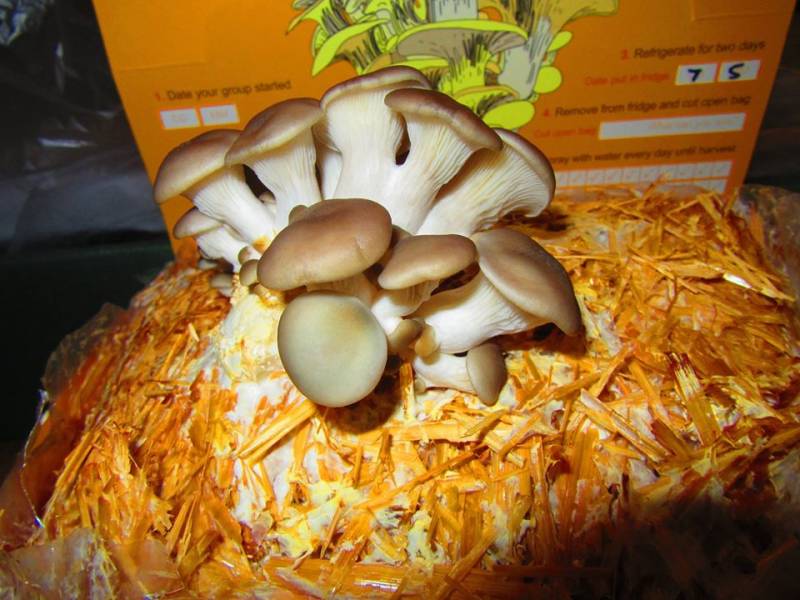
Indoor Mushroom Kits – Oyster Mushrooms.
We were once lucky enough to receive a free mushroom kit from Kew Gardens. We applied for and received a Grow Wild Kit for the orchard which included lots of wildflower seeds and a very interesting Oyster mushroom fungi kit. We followed all the instructions – kept it in the dark for a month, then 2 days in the fridge (to mimic winter) & then opened up & some tiny mushrooms appeared. It was amazing to see how fast they grew.


In Penbeagle hill above us we’ve seen ‘Yellow Brain’ fungus & there’s lots of ‘Beard Lichens’ on the trees.
Posted by Elise Langley, 5th May, 2020